Information
Photography
Syndicate This Blog


Thursday, December 17. 2015
Late Fall Riding Views
 |
| From Motorcycle Adventures |
It is a great time of year to ride on those narrow back country single lane pavement and packed dirt roads, as normally the dense trees along many of these roads are particularly effective at blocking the view. Slower speeds involved on such roads allow longer riding times between warm up stops. Care does need to be taken as such roads are poorly maintained, particularly an issue if it is below freezing and/or the ground is frozen, which makes these roads a better late fall choice than winter.

Wednesday, October 7. 2015
2015 Honda Rebel Rally
 |
| From Motorcycle Adventures |
Fortunately it cleared up on Friday the 11th, so I headed out at my usual time. It was a gorgeous ride out with clear skies and nice weather; until I got within a few hours of Lake Hope. As I approached it became clear storms and rain were prevalent over the park; a particular issue for someone planning on setting up a tent, compounded by the fact that it would be both raining and dark when I arrived. I contemplated the idea of camping to the east where it wasn't raining, but the forecast made it clear that wouldn't help as it would be raining Saturday. So for the first time on one of these trips, I stayed in a hotel in Parkersburg, WV.
It was still raining in the morning, but with daylight to ride, in I proceeded to Lake Hope. When I arrived I didn't find any Rebels; it turns out I missed the pack leaving by 50 minutes. After enjoying a fine meal at the lodge and generally puttering the park around for a few hours, the rain finally relented so I headed to my campsite to set up. Afterwards, I went for a ride to Ash Cave, a few trips on the Zaleski roller coaster, and a few of the other wonderful motorcycle roads around the park.
By then evening had arrived, the party had returned to the cabin area and had a campfire going, so I joined in. Although the party was small; the rain had scared off most of the riders it seems; there was plenty of fun conversation and Guba's famous chili to enjoy.
Sunday we enjoyed Lake Hope Lodge's breakfast buffet which includes their delicious brisket. Afterwards, I hung around the park, explored the campground and some trails around it. Guba stopped by with a large pile of firewood, and B.O.B. the bear. After dark, DNC stopped in and we enjoyed a fine campfire on a glorious clear night full of stars; a fun change from year's past where I'm usually the only one still there.
B.O.B. the bear (shown in the picture) has been riding around the country on Rebels for 10 years. Apparently I was the only one at the Rally who hadn't ridden with him yet, so he accompanied me on the ride home. Now to plan some trips with B.O.B. before I hand him off to the next Rebel rider . . .
Friday, May 1. 2015
2014 Triumph Street Triple
 |
| From Motorcycle Adventures |
I was hesitant to go with a Triumph after other experiences the family has had with them. However, this one being inexpensive, and hoping that was a two-off problem, I decided to try one. Alas, I had issues too; there was a defective part and Triumph apparently isn't open Saturdays to provide any support to their dealers, and they don't provide adequate documentation or instructions to dealers as to what the computer codes mean. This resulted in a bike that wouldn't start, then one throwing error codes. Unfortunately this means my family is 3 for 3 with Triumphs not working off the showroom floor; fortunately the dealer got it working the next week and I hit the road.
Amazingly smooth bike; I'm still in break-in so I haven't had a chance to push it yet, but handling and weight are similar to the 250. I love the 'sitting on the hood' feeling which is more extreme with this bike than my other ones; it's easy to forget the bike is there. I had some concerns the bike would be too powerful, but it has very good manners; smooth and controllable power with more only if asked for.
With my Ventura Rack and Scottoiler installed tonight, I'm ready to start tackling longer distances with it.
Saturday, February 28. 2015
Siberian Winter
 |
| From Motorcycle Adventures |
Finally as of today we had enough days in a row of sun to clear the roads of ice, and with the balmy 20F degree day I got a chance to hit the roads before February ends. My first ride of the year, although shorter than I would have liked, was glorious indeed.
If next winter is like this again, I might have to invest in a snow cycle (aka snowmobile) to make it through these trying times.
Monday, February 16. 2015
AFX Giant Raceway
 |
| From Slot Cars |
 |
| From Slot Cars |
It took a while to set up, a few decorative rocks to tweak the heights so the car drivers don't lose their heads, and quite a bit of testing and tweaking the many feet of seams, twists, and turns to get running smoothly. As such I certainly wouldn't recommend this as a 'first' set lest one get discouraged, but once set up it is quite amazing. With some extra landscaping pieces from my collection of HO scenery, and the included pit and grandstand displays which are a nice extra touch, this set has certainly lived up to my expectations.
Thursday, January 22. 2015
Bread Machine Bliss
 |
| From Cooking |
By this point in time we have tried quite a few recipes. Our favorite so far is undoubtedly one originally based on this Light Oat Bread recipe but with a few changes to match our tastes:
- 1 1/4 cups water
- 2 tablespoons soft butter
- 1 teaspoon salt
- 2 cups bread flour
- 1 cup whole wheat flour
- 1/2 cup old fashioned oats
- 1 tablespoon brown sugar
- 1 packet active dry yeast
It's interesting how sensitive these recipes are; with more experience I hope to get more consistent round tops for example. So far though, we've devoured every loaf.
Beyond bread, there is a recipe in the book for pizza crust. Although it took 1.5 hours on the dough setting, it made the best pizza crust I've ever managed to turn out. Looking forward to more dough recipes, and I need to try rolls at some point.
Thursday, January 1. 2015
CB Channel 38 LSB
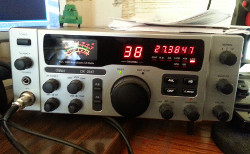 As I study for my Ham Radio Technician exam, I picked up a Galaxy DX 2547 CB base station and set up an I-Max 2000 antenna in the back yard. Being near a highway, I figured I would at least pick up some truck traffic and see if there's anything interesting going on nowadays on the unlicensed CB airwaves before I'm ready to expand into licensed spectrum.
There's no shortage of the expected truck traffic, which is sometimes interesting. And there's something called the 'super bowl' on channel 6 of people who use ridiculous overpowered transmitters to communicate over long distances. CB is very wild west nowadays as far as traffic and enforcement; rules which used to be ironclad like channel 9 being for emergencies are now widely ignored. Whether this is good or bad is another argument, but at least the frequencies are being used.
My first CB radio supporting single side band, I did some research on line which indicated SSB in the CB space is usually used on channels 35-40, and English traffic is usually Lower Side Band. Hanging out in these channels, there is indeed much interesting traffic. Today for example I was picking up long range DX traffic between members of the World Radio Club. I'm regularly hearing traffic here between Texas, Montana, New York, Pennsylvania, etc.; but of particular interest today was traffic from Great Britain and Portugal. I also periodically pick up CW (morse code) traffic, which research indicates is often survivalists communicating with each other, although I won't know more until I learn CW. Of greater interest in the standpoint of what I would actually want to participate in, there is also some local traffic in my area on these bands.
Wednesday, December 17. 2014
Wargame Trilogy by Eugen
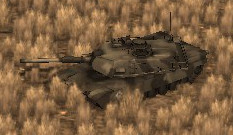 As more games become available for Linux on Steam, I've been adding to my collection. Although I don't get much time to play, I like to support bringing titles to the platform with my dollars. Of the ones I have tried, the Wargame series by Eugen Systems has been a standout.
Purchasing the trilogy during a sale, I started with Wargame: AirLand Battle due to it having a tutorial as a starting point. Going into this game thinking it was a more typical RTS, I quickly found out just tossing your units at the enemy results in a quick loss. The game has a dizzying array of units modeled on real world counterparts, and requires knowledge of how to use reconnaissance and correct unit selection and tactics. Unlike other games where one can just crank out more units if a strategy doesn't work, this game has 'decks' of available units. Just like in a real battle resources for each action are limited, and there's no time spent building bases and collecting resources.
In one of the tutorial missions I went in not realizing how the game works, and began to use the usual RTS tactic of building tanks then working my way up the map to clear each area in turn. By the time I got to the top, I had plenty of 'resources' (action points in this game), but was confused; why couldn't I build more tanks? By this time the AI was tearing my tanks to pieces with their air force and I was getting quickly overrun by their tanks. Reading more about why I lost and how the game actually works online, I tried another strategy next time; instead of wasting resources fighting battles that didn't matter, I flanked the enemy and cut off their air corridor. This time, with logical tactics, I won easily. I've been hooked ever since.
Thursday, November 20. 2014
Now on Linked In
I have resisted creating a LinkedIn profile for a while now as I didn't want to manage yet another social media site I won't use. However, as it seems to be a prominent place for career connection building, I decided to give it a try.
Especially as it is more about connections than posting content, it will be interesting to see if it brings any friendships or opportunities my way.
Especially as it is more about connections than posting content, it will be interesting to see if it brings any friendships or opportunities my way.
Thursday, November 6. 2014
Kawasaki Voyager 1700 ABS
 |
| From Motorcycle Adventures |
Finding one in Altoona at Steve Seltzer Powersports in the Pearl Alpine White / Pearl Luster Beige color combo, from the pictures I actually thought it would be too gold to appeal to me, but in person it is a mellow tan and off white combo which I enjoy. I have been debating various ways to add orange highlights, but will likely leave it unmodified at least for a while.
Rode it west of Cleveland and back over the weekend; I have no regrets trading the vStar 950 in for this one. Although I loved the looks of the 950, the cockpit dimensions never really fit me and I wasn't comfortable on it even after 21,000+ miles of riding. I regularly scraped the floorboards with the 950, but the Voyager actually has better clearance and better handling; certainly something I didn't expect moving up to a full dresser. I also really like the high seating position on this one; it feels more like I'm on top of the bike and looking over the fairing; no doubt one of the reasons I liked the test ride as it feels more open. I am thinking the full faired front is going to be too hot in the summer, but I have other rides for those hot days. That warm engine heat makes trips to Ohio in November significantly more comfortable.
Wednesday, September 17. 2014
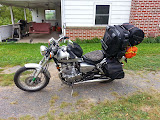
2014 Lake Hope Rebel Rally
 |
| 2014 Lake Hope Rebel Rally |
Continue reading "2014 Lake Hope Rebel Rally"
Wednesday, April 2. 2014
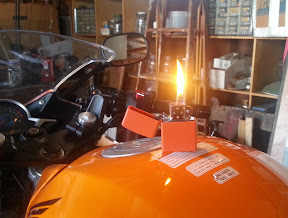
Need a Light?
 |
| From Miscellaneous |
Sneak behind older gents who used to smoke, click it open and closed (it has very distinctive clink sounds) and see them perk up. Then hide it before they turn around . . .
Monday, January 27. 2014
HP 50g Graphing Calculator
 |
| From Miscellaneous |
Late in the lifespan of these devices, they became more sophisticated, with modifier keys and functions layered upon functions. This particular model, the last of HP's RPN calculators; an entry language which made it quick and easy to enter complex formulas into such devices in a format easy to make corrections; made use of the limited screen technology of the time to display graphs and formulas in a manner similar to that actually written in a paper technology of the time called textbooks.
I could not afford one of these back in these days of yore, but they are actually still produced, and quite inexpensive likely due to low demand and reduced costs replicating a design from a past decade. I purchased one for use on my electronics workbench, where it is proving handy as it has a built in store of electronics formulas and constants to do quick calculations without needing to hunt for a relevant application using the computer on the other side of the bench. Like slide rules for generations previous, some benefits still exist for users of these old technologies, providing insights into how pieces of our individual reality function. Mathematics, a man-made invention to annotate the workings of the universe, continues to provide interesting tools as in tandem they become iteratively more sophisticated.
Sunday, January 5. 2014
Kubota B3200
 |
| From Miscellaneous |
John Deere and Kubota were both at the top of my list for evaluation, but our local John Deere dealer (Lost Creek Implement) closed. C.H. Waltz was a logical choice, as I drive by a couple of their dealerships regularly in the course of going to and from work.
Kubota's B3200 hit all my critera for the right price, so I jumped on this one; especially as they had a used snowblower in stock. Although we haven't gotten much snow lately, I've always wanted a snowblower but the walk behind models aren't practical when our lane is 1/4 mile (about 400 meters). A fortuitous choice this year, as this is the first year in a while we have gotten a real winter.
Wednesday, July 3. 2013
How Much Wood Would a Wood Chipper Chip . . .
 |
| From Miscellaneous |
As the other maintenance item with a large yard due to the many trees is trimming around said trees, wood chips seem a logical use for this stack-o-branches. My local lawn equipment shop, R. E. Davidson & Son has a line of DR Chippers, so I decided to try one.
With a large backlog of wood to test with, I have no shortage of test samples. This chipper makes short work of anything I can fit in the hopper; even some large walnut I'd classify more as logs than branches are quickly ground into little bits. Being a chipper and not a shredder, it doesn't process smaller limbs alone particularly well, but it has no problems with small stuff when it is pushed in with some larger branches.
They did go a bit cheap on the engine mount; with it bolted right to the frame it shakes fiercely when starting up. I do worry that might result in long term maintenance issues or broken engine components, although it does seem to smooth out nicely once going full speed. My other complaint is the chute. Although the little one included is mostly fine for my needs, it shoots the material out a bit too close, and as can be seen in the picture, I had to shovel my wheel out. I might end up purchasing the larger chute to fix that issue.